In this guide
- What a Water Spot Actually Is
- Before You Touch Anything: Which Kind of Spot Are You Looking At?
- Removing Water Spots, From Gentlest to Most Aggressive
- Water Spots on Glass Are a Special Case
- The Home Remedies and Myths, Honestly Assessed
- Are Water Spots Permanent?
- Prevention: The Part That Actually Saves You
- The Root Cause: Doing Something About Your Water
- Adapting All of This to Kuwait's Heat and Hard Water
- The Short Version
How to Remove Water Spots and Hard Water Stains From Your Car
You wash the car, dry it off, and it looks flawless in the garage shade. Back it out into the sun and there they are: dull white rings across the doors and hood, cloudy patches on the glass, a chalky film on paint that was mirror-clean an hour ago. You wipe one with your thumb and it barely fades. Wash the whole car again and half are still there, mocking you.
Search for a fix and you find camps that seem to hate each other. One video swears white vinegar dissolves everything. A forum insists WD-40 makes them vanish. A detailer tells you the only real answer is to machine-polish the paint. A car-wash chain just wants your money. But underneath all of it is something simpler: most fresh water spots wipe off in minutes if you know how. A few have already damaged the paint and need real correction. The single biggest thing that decides which camp you're in? Almost nobody explains it first.
This guide walks through all of it plainly. What water spots actually are. How to tell which kind you're looking at before you touch anything. How to remove each one, from gentlest to most aggressive. What the home remedies actually do. Whether the damage is permanent. And how to stop spots coming back in Kuwait's heat and hard water. By the end you'll know what to do, what to skip, and why.
What a Water Spot Actually Is
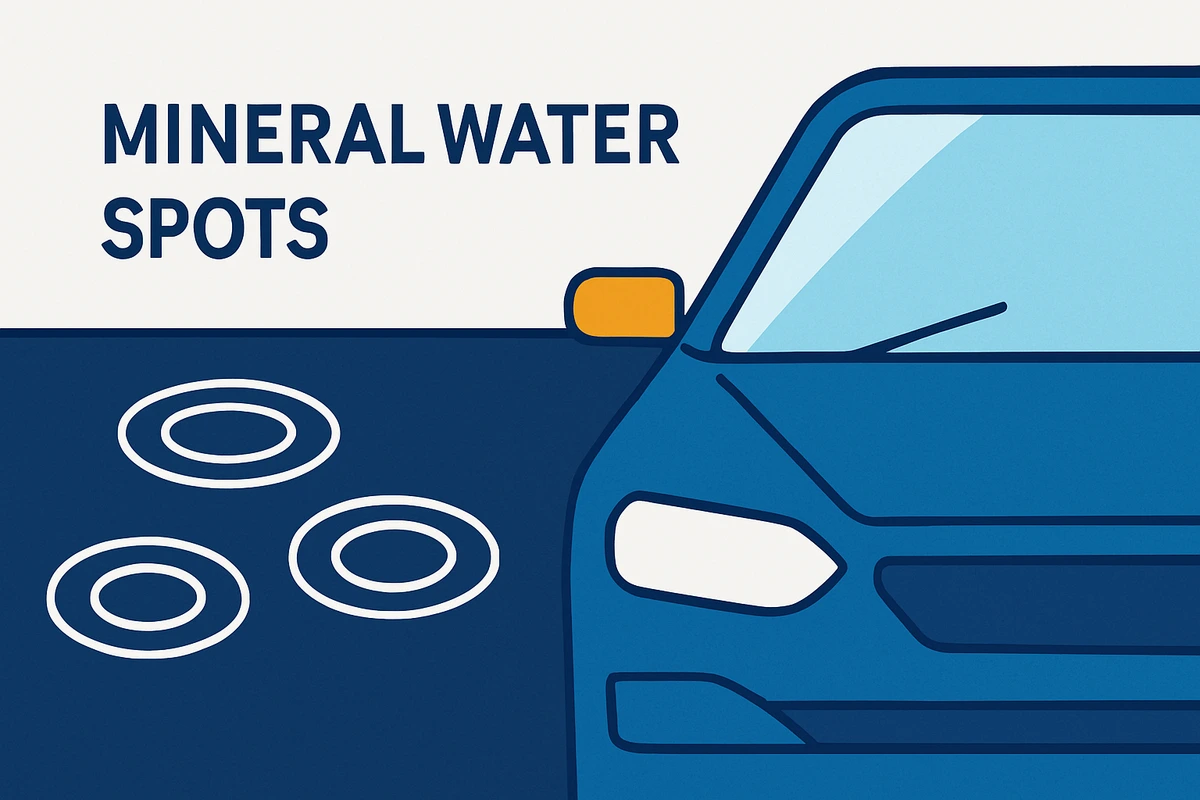
A water spot forms when a droplet lands on your paint or glass and evaporates. The water leaves. Everything dissolved in it does not. As the droplet dries, minerals suspended inside get deposited on the surface as a stain, a tiny ring of residue exactly where the drop was (Chemical Guys). Repeat that a few hundred times across a panel and you get the dull constellation of spots you're staring at.
This is why the spots showed up after you washed, not before. The wash water is the source. Tap water, hose water, lawn sprinklers, rain, or road spray all carry dissolved minerals and other junk. The type and amount vary by region depending on how "hard" the local water is (Adam's Polishes). The harder your water, the heavier the spotting. Rain picks up airborne pollution, dust, and whatever it ran across on a roof or tree before hitting your car. Road spray is an almost unknowable mix of dirt, oils, and grime.
Key terms
- Water spot
- A tiny ring of mineral residue left behind when a water droplet evaporates on paint or glass. The water leaves; the dissolved minerals do not.
- Hard water
- Water with high mineral content (Turtle Wax Pro). When it dries on a panel, those minerals stay behind as stubborn white stains. Soft water can still leave spots — it still carries dissolved solids that get left behind when the drop evaporates.
- TDS (Total Dissolved Solids)
- The total mineral load in water. The higher the TDS, the more spotting you get (Aquatell). Reverse osmosis reduces TDS by roughly ninety-five percent, which is why professional washes use it for a spot-free final rinse.
Before You Touch Anything: Which Kind of Spot Are You Looking At?
This is the step almost every guide skips. Skip it and you waste an afternoon scrubbing or worse, jump straight to polishing paint that only needed a wipe. Not all water spots are the same. Some sit on top of the paint as surface stains you can lift off. Some have bonded to the surface and need a chemical to break them loose. Some have etched down into the clear coat, physically eaten a pit or ring below the surrounding surface, and wiping will never bring them back (Dr. Beasley's). Knowing which one you have before choosing a method saves time and stops you from reaching for an abrasive before you need it.
Rough diagnosis takes under a minute with your hands and eyes. Wet the affected area with a sponge or microfiber towel and look closely. Ring marks around the spots? Surface feels rough and crusty under your fingertips? You're dealing with a more severe, mineral-heavy deposit rather than a light fresh one. The single most useful test is simpler: wash the car normally and see what's left. Fresh, light spots are just surface stains sitting on the paint, and a proper contact wash will usually take them off. Whatever survives that wash is bonded or etched, and tells you how far up the ladder of aggressiveness you need to climb.
Think of it as a progression. A fresh droplet that dried an hour ago is the easiest case. Leave that same droplet overnight and the mineral deposit sticks harder. Let mineral water dry on the paint again and again, baked on in the sun, and a surface stain turns into a bonded deposit. Push it further and the corrosive elements in the water etch a ring or crater into the clear coat itself. That's when the spot becomes permanent damage rather than a stain. Good news: the vast majority of everyday spots never get past the first two rungs. Always start at the bottom of the ladder and only climb as far as you must.
Removing Water Spots, From Gentlest to Most Aggressive
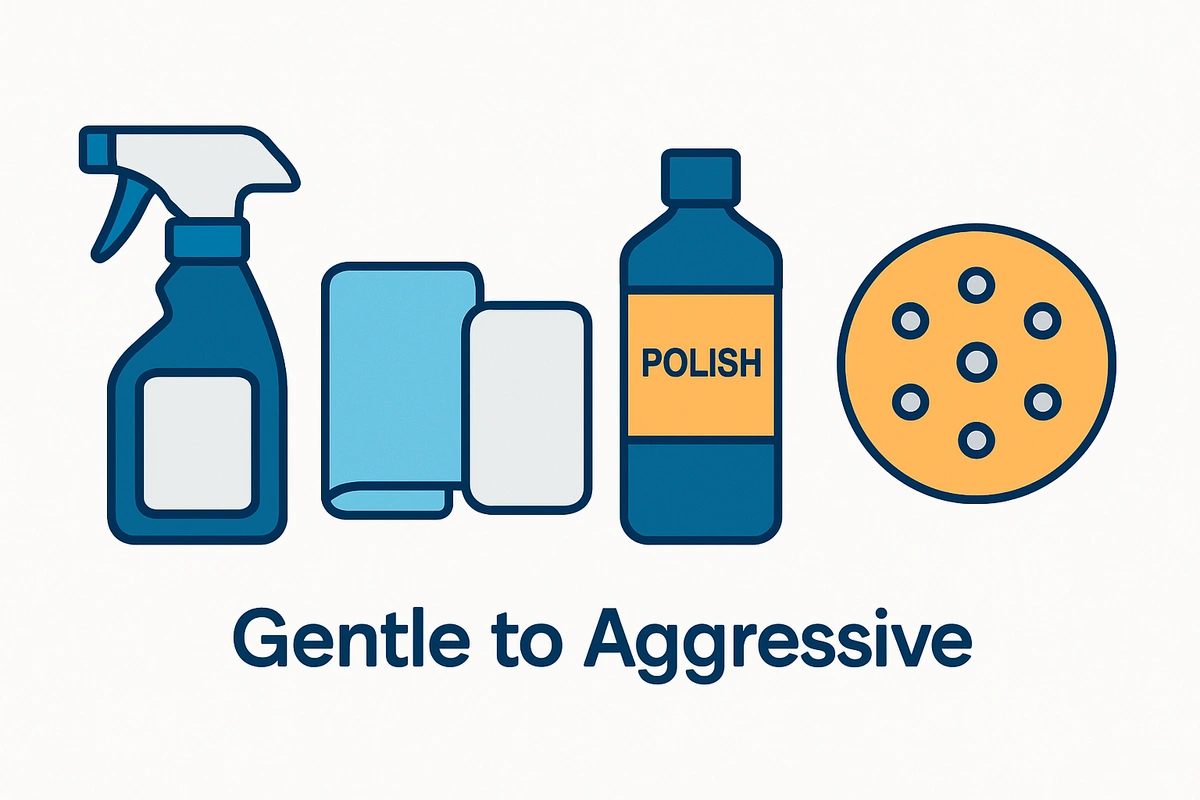
Always try the least aggressive method first, confirm the result, and only step up if it fails. Work the other way and you put new damage into your paint trying to fix old stains.
-
1
A Proper Wash
Don't underestimate this. Fresh, light spots are surface stains not yet bonded to the paint. A normal contact wash with a good wash mitt and quality, pH-balanced car shampoo removes most of them outright. If the spots are new, there's a real chance they simply come off at this stage and you're done. For very light spots you don't even need a full bucket wash. A wipe-down with a waterless wash or quick-detail spray and clean microfiber towel can be enough. Wash first regardless of your next move because you want to clear away loose grit before you start rubbing, so you're not dragging dirt across the paint.
-
2
The Vinegar Method
This home remedy actually has chemistry behind it. White vinegar is mildly acidic, and that acidity breaks down the mineral deposits that make up a water spot. It's gentle enough to be safe on paint when diluted and used out of the sun. The method most sources agree on: one-to-one mix. Combine equal parts white vinegar and water, apply it to the spots with a microfiber towel or sponge, let it dwell a few minutes so the acid has time to work on the minerals, then rinse it off. You may need to repeat it a couple times for stubborn spots. Use distilled water in the mix rather than more tap water — tap water can carry the very minerals you're trying to remove, whereas distilled water is free of them (Take 5). For best results rinse the treated area with distilled or reverse-osmosis water before drying, so you're not laying down a fresh set of spots as you finish. Work out of direct sunlight and reapply your protection afterward — vinegar is an acid and a stronger version of this approach will degrade the wax or sealant layer on the paint. Any area you treat should be re-waxed or re-sealed once the spots are gone.
-
3
A Clay Bar
If a spot has been sitting long enough to bond but hasn't etched, a clay bar is often the tool that finally lifts it. Clay pulls bonded contamination off the paint surface without abrading it, which makes it perfect for water spots a wash left behind. The process is straightforward: lubricate the surface generously with a detail spray, then glide the clay back and forth over the area with light pressure. Spend extra time working the spots from several directions to give the clay the best chance to grab the deposit. A second pass may be needed. Always keep the surface well lubricated because that lubrication is what keeps the clay from marring the paint.
-
4
A Dedicated Water Spot Remover
When a bonded spot resists a wash, vinegar, and clay, the next step is a purpose-made water spot remover. These are stronger, often acidic chemical formulas designed specifically to neutralize the minerals and chemically lift the stain off the clear coat. Because these products are acidic, you must neutralize them afterward, either by rinsing thoroughly with clean water and drying, or by cleaning the area completely with a waterless wash, so no active chemical is left sitting on the paint. Read the label carefully because these aren't all used the same way. Some go on dry paint, others on wet paint, and some are designed to be worked in during the wash itself. Follow the manufacturer's instructions exactly. After you've chemically lifted a bonded spot, seal the paint back up with a wax, sealant, or coating.
-
5
Polishing and Compounding (When the Spot Is Etched)
This is the last rung, and it's a different kind of job. You're no longer removing a stain — you're removing paint. If a spot has etched a ring or pit into the clear coat, the deposit is no longer on the paint, it's in it. The only way to erase it is to mechanically level the surrounding clear coat down to the depth of the etching. That means a machine polisher with a polish or compound. Even here the least-aggressive rule holds: start with a light polish and soft pad, inspect the result, and only step up to a heavier compound and more aggressive pad if the polish alone won't level the etching. Then drop back down to refine. Always test your process on a small area, around two feet by two feet, before committing to the rest of the panel. Removing bonded contamination can sometimes leave the affected area looking dull or slightly pitted, which then needs polishing to restore.
The deepest etchings — the crater kind that come from badly contaminated water — can be so deep that trying to grind them out risks cutting through the clear coat and exposing the paint underneath. This is the point where a careful amateur should stop and hand the car to someone with paint-correction experience. The failure mode is no longer a stubborn spot — it's a burn-through that needs repainting. Paint itself varies in hardness, so the right polish-and-pad combination for one car isn't right for another, which is exactly why you test first.
Water Spots on Glass Are a Special Case
Glass follows the same ladder as paint, but with two differences worth knowing. Glass is far harder than clear coat, so it tolerates more aggressive correction when gentler methods fail. The vinegar mix, window cleaner, and a dedicated water-spot cleaner all work on glass much as they do on paint. But there's one specific hazard: a strong acidic water spot remover can cause permanent cloudiness or haze on glass if used improperly. It's best avoided on glass, or used only as a last resort after practicing on a spare piece of glass you don't care about. If nothing gentler works on truly stubborn glass spots, very fine 0000-grade steel wool with plenty of glass cleaner as lubricant can be worked over the affected glass with light pressure. But mask off the surrounding trim and paint first because steel wool will scratch paint instantly.
The Home Remedies and Myths, Honestly Assessed
The search results are full of quick fixes. Here's what actually holds up.
White vinegar: real. Covered above. It genuinely works because its acidity dissolves the mineral deposit, and it's gentle enough to be safe on paint when diluted and used out of the sun. It's the one kitchen remedy worth keeping.
Baking soda: plausible for spot treatment, with limits. A paste of baking soda and distilled water applied to a spot, left a few minutes and then rinsed away, is another mild treatment for lifting mineral deposits. Use distilled water in the paste for the same reason as the vinegar mix, and treat it as a gentle option, not a scrubbing compound.
WD-40: this is the myth to be careful with. None of the detailing sources that actually explain water-spot removal use WD-40 as a remedy, and for good reason. A water spot is a mineral deposit. Removing it means dissolving those minerals, physically lifting them, or leveling etched paint. A spray lubricant does none of those things. Treat "spray it and they disappear" as cosmetic sleight of hand, not a fix. Reach for vinegar, clay, or a proper remover instead.
"Just run it through a car wash": partly. Whether a car wash removes your spots depends entirely on which rung of the ladder they're on. A wash reliably removes fresh, surface-level spots because those are exactly what a wash is designed to lift. It won't remove bonded deposits or etched rings, which need chemistry or correction. So a car wash is a fine first move and a useless last resort.
Household dish soap as your regular wash: don't. It's tempting to think a strong degreaser like dish soap will cut mineral spots better, but it works against you over time. Household cleaning agents like dishwashing detergent aren't formulated for automotive paint and can strip off the protective wax that helps resist spotting in the first place (Consumer Reports). Use a proper car shampoo and keep your protection intact.
Are Water Spots Permanent?
The honest answer: it depends entirely on how far the spot has progressed, which is why the diagnosis at the start matters. Caught early, a spot is a surface stain that wipes off during a wash or with a quick detail spray. If that fails, a clay bar usually gets it. Left to bond, it needs a dedicated remover but is still removable without abrasion because it's still on the paint rather than in it. Once a spot has etched into the clear coat, it can no longer be wiped or dissolved away. It can only be polished or compounded out by physically leveling the paint, and the deepest craters may not come out at all without cutting through the clear coat.
"Permanent" is really a description of neglect. The same spot is trivial on day one, a chore after a week in the sun, and a paint-correction job after months. The lesson writes itself: deal with spots early. Don't let them sit.
Prevention: The Part That Actually Saves You
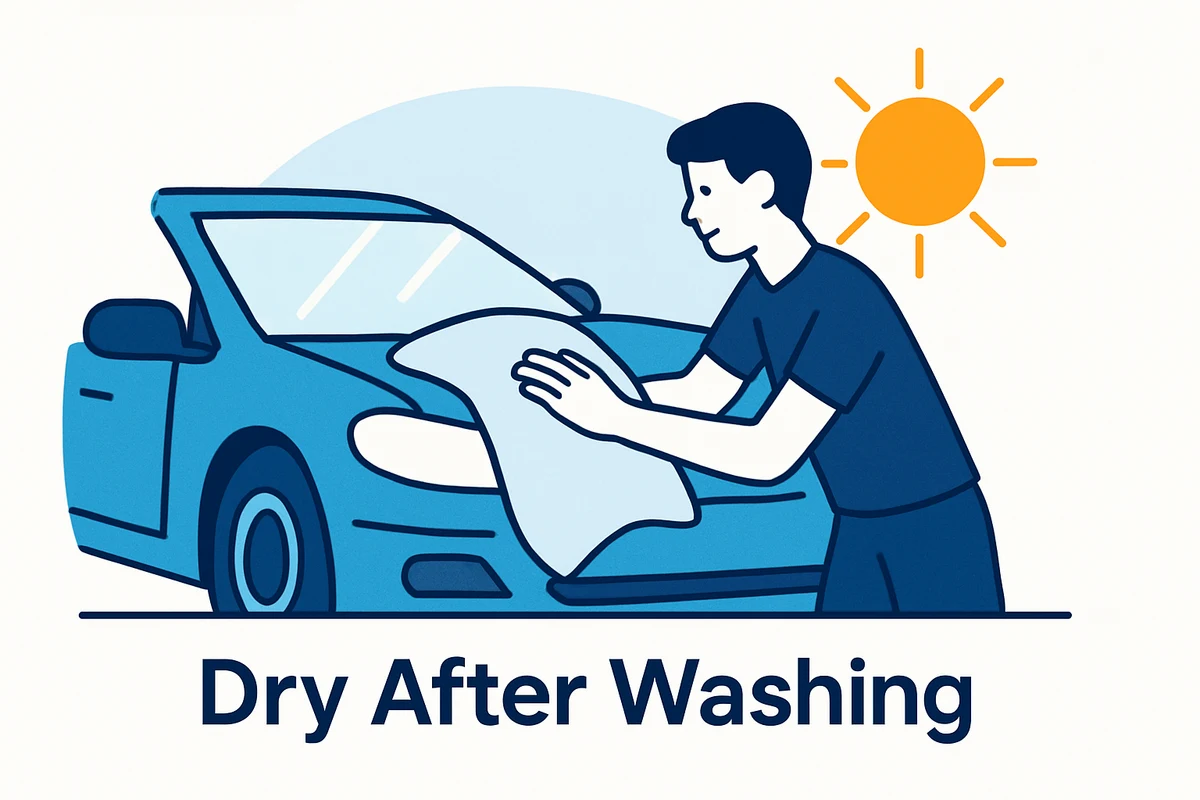
Every source that discusses water spots eventually lands on the same conclusion, and it's the least glamorous one: the best way to remove a water spot is to never let it form. Prevention genuinely works better than any remover. It comes down to controlling two things: standing water and the minerals in it.
- Dry the car, and dry it fast. A water spot needs a droplet to sit and evaporate. Take away the sitting and the evaporating and there's no spot. The most important habit is simply to dry the car thoroughly after every wash rather than letting it air dry. Don't let the car air dry and don't expect a quick drive to do the job because either will leave watermarks caused by the minerals in hard water. The drier the car, the less chance it has to spot or streak. Use a soft, non-abrasive drying towel because an abrasive towel trades water spots for hairline scratches.
- Stay out of the sun. Heat is the accelerant. When your car is wet and sitting in direct sunlight, water spots form very quickly because the water evaporates before you can wipe it away. Don't wash the car when the body is hot, whether from driving or from sitting in the sun. Heat speeds the drying of soap and water, makes the whole job harder, and increases the chance that spots and deposits form. Wash and dry in the shade on a cool panel and you remove the single biggest thing working against you. On any sunny day, make a point of removing standing water from the paint rather than leaving it to bake.
- Keep a layer of protection on. A durable protective layer doesn't stop minerals landing on the car, but it changes what happens next. Maintaining a coat of wax, sealant, or ceramic coating helps prevent minor spotting and lessens the impact of harsher conditions. It makes any spots that do form far easier to remove because the protective layer keeps them from etching down into the clear coat. A ceramic layer works much like wax but is tougher, adding a barrier against contaminants including natural minerals and making it harder for spots to stick. This is also why you re-seal any area after you've treated it with vinegar or an acidic remover. Protection turns a potential etch into a wipe-off.
The Root Cause: Doing Something About Your Water
Everything above treats the symptom. If you're tired of fighting spots every single wash, the real lever is the water you rinse with. This is where a lot of well-meaning advice gets it wrong.
The instinct is to assume a home water softener will give you a spot-free wash. It usually won't, and the reason is worth understanding. Water hardness — the calcium and magnesium content — is only part of the total mineral load. What really predicts spotting is the total dissolved solids, or TDS, in the water. The higher the TDS, the more spotting you get. A softener doesn't actually remove minerals. It exchanges the hardness minerals for sodium, so softened water ends up with less calcium but more sodium and essentially the same TDS as before. You still get spots. The one genuine advantage is that the sodium deposits left by softened water are easier to wipe off than the hard scale left by calcium and magnesium. So softening makes the spots easier to remove, not absent.
The methods that actually deliver a spot-free rinse work by cutting the mineral content itself. The best water to wash with is water low in TDS. Reverse osmosis reduces the TDS of water by roughly ninety-five percent and assures a spot-free rinse with most water supplies, which is why many professional washes advertise a "spot-free rinse" using reverse-osmosis water for the final pass. At home, the accessible version of the same idea is distilled water, which is water with the impurities removed. It's the best choice for a final rinse precisely because the spots were formed by mineral-laden water in the first place. If you have hard water and don't realize it, that unseen mineral load is the thing quietly generating spots on every wash. Switching your final rinse to distilled or reverse-osmosis water is the fix.
One useful curiosity for anyone who waxes: the hardness in your water actually helps at the very end of the process. Waxes and drying agents work better in hard water than soft because their chemistry doesn't react with the hardness minerals. Hard water's high surface tension means the droplets bead up and are easier to blow or wipe off rather than clinging and drying in place. It's a small consolation, but it explains why a freshly waxed car sheds water so much more cleanly than bare paint.
Adapting All of This to Kuwait's Heat and Hard Water
If you're washing a car in the Gulf, two local conditions turn water spots from an occasional nuisance into a near-constant battle. Both amplify the exact mechanisms described above.
First is the sun. In a climate where surfaces sit under intense heat for most of the year, a wet car left in the open spots almost instantly because the water evaporates before you can dry it. This is the fast-evaporation trap that direct sunlight creates. Washing a hot panel makes it worse since heat speeds the drying of soap and water and drives up the odds of spotting. The practical response is discipline: wash early in the morning or in the evening, always in shade, work one section at a time so no panel sits wet long, and dry each section immediately rather than washing the whole car and then drying. In heat like this, the standing water that a cooler climate lets you leave for a few minutes has to be removed straight away. Heat also raises the stakes on neglect: a spot left to bake on a hot panel bonds faster and is more likely to etch. The "deal with it early" rule matters even more here.
Second is the water itself. If your tap water is hard, as household water in much of the region tends to be, every rinse is depositing a heavy mineral load. That's the engine behind the spotting. You can't change the climate, but you can change your rinse and your routine. Keeping a durable coat of wax or ceramic protection on the paint is doubly worthwhile in these conditions because it both slows spotting and keeps whatever spots do form from etching in the heat. And where practical, giving the car a final rinse with distilled or reverse-osmosis water removes the minerals that would otherwise dry into spots on the next sunny afternoon. None of this requires special skill. It requires washing at the right time of day, in the shade, and drying fast. In a hot, hard-water climate that's most of the battle.
The Short Version
The bottom line
Water spots are minerals left behind when water dries on your car, and how hard they are to remove depends on how long they've been left and how much heat they've baked in. Start by washing; most fresh spots come off there. Step up only as far as you need to: vinegar and distilled water for the stubborn ones, a clay bar for bonded deposits, a dedicated remover for what's left, and machine polishing only for spots that have actually etched into the clear coat. An inexperienced hand risks doing more harm than the spot. Be extra careful with acidic removers on glass. Ignore the WD-40 shortcut and the dish-soap idea. Above all, prevent. Dry the car fast. Keep it out of the sun while wet. Keep a layer of wax or coating on the paint. If hard water is the root of your problem, move your final rinse to distilled or reverse-osmosis water. Do that consistently and the spots stop being something you remove and become something you simply don't get.
If the heat, dust, and hard water of Kuwait have you fighting the same spots after every wash, Master Wash brings a proper mobile car wash to your door. We wash, dry, and protect your car the right way, at the right time of day, so water spots never get the chance to set in. Reach out whenever you'd rather the spots were our problem than yours.